Multilingualism in young children — why it pays to start as early as possible
“Won’t my child get confused with three languages?” — we hear this question from parents very often. And we understand it completely, because until recently it was widely believed that exposure to several languages at once could harm a child. Modern science, however, says something quite different — and these findings are worth knowing, because they can change many parents’ perspective.
A child’s brain is made for multilingualism
Research on language development shows that young children are exceptionally well prepared to acquire more than one language (Byers-Heinlein and Lew-Williams, 2013). Babies can distinguish the sounds of all the world’s languages — this ability gradually narrows at around 10–12 months, when the brain begins to specialise in the sounds it hears most often (Kuhl, 2004). Early, regular contact with a language allows a child to get to know it naturally, in everyday situations.
What is more, bilingual and multilingual children develop stronger so-called executive control — the ability to switch attention, inhibit impulses and think flexibly. This is because their brains are constantly practising “managing” several language systems. A review by Bialystok, Craik and Luk (2012) describes such benefits at different stages of life, as well as data suggesting that bilingualism may be associated with a later onset of dementia symptoms. Some of these findings are still debated by scientists, which is why for us the most important benefit remains simply being able to communicate freely in several languages.
Natural immersion instead of artificial lessons
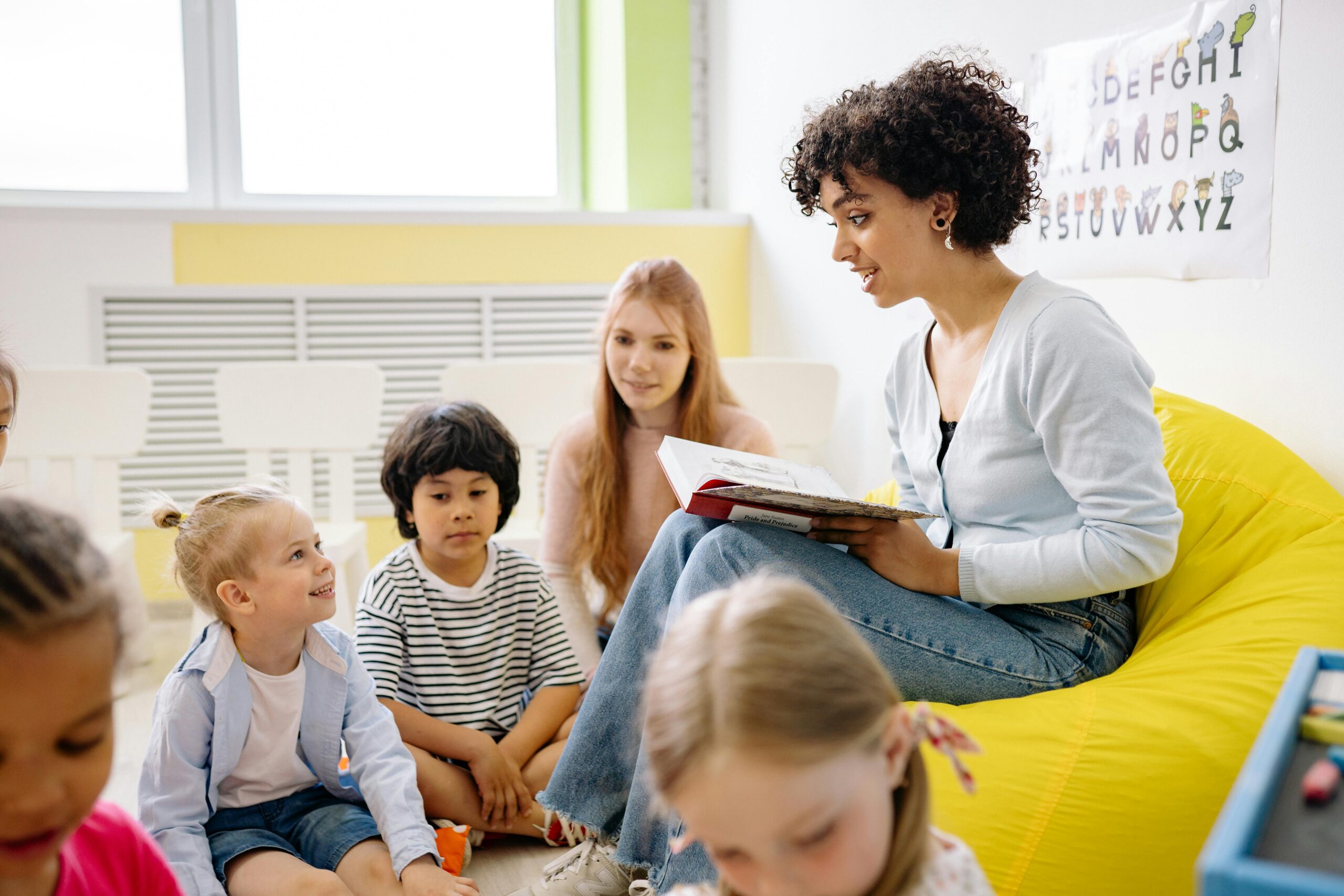
The key question is not “should we teach children languages?” but “how should we do it?”. At Accademia dei Piccoli we chose the path of immersion — natural exposure to the language. Our children do not learn English or Italian in school-style lessons — they live in these languages every day. English is taught by our English teacher, who lived for several years in English-speaking countries — she simply talks with the children, sings songs, reads books and leads games. Italian is present throughout the day — at mealtimes, in play, in songs and in Italian traditions. Language becomes a tool for communication, not a school subject.
It makes a huge difference. When a three-year-old hears the teacher say “andiamo a giocare nel giardino” while seeing everyone heading out to the garden, they understand, because the context suggests the meaning. They do not need a translation. Their brain builds connections between words and experiences, exactly as it did when learning their first language. Linguists call this “acquisition” as opposed to “learning” (Krashen, 1982) — and this is what our language work at the preschool is built on.
The silent period — don’t be afraid of it
One of the biggest sources of worry for parents is the so-called “silent period”. A child who is starting to get used to a new language may not speak it for a while — even though they clearly understand. This is natural and well described in the literature — researcher Patton Tabors calls it the nonverbal period (Tabors, 2008). The brain needs time to process and organise new language material. When the child finally starts speaking, they often surprise adults with how much they already know.
This is what it usually looks like: for several weeks a child listens attentively to Italian songs, and then starts humming them; they do not answer questions in English until one day they ask for a second helping in English all by themselves. These moments are magical — and they confirm that patience pays off. Our job as teachers is to accompany the child patiently through this process, without pressure and without judgement.
Mixing languages is not a mistake
Another myth worth tackling: mixing languages within one sentence is not a sign of confusion or delay. Researchers call this code-switching and regard it as a typical phenomenon in the development of bilingual children (Byers-Heinlein and Lew-Williams, 2013). A child who says, for example, “Mamo, daj mi il pennarello rosso” is not confused — they simply reach for the word that comes to mind fastest at that moment, regardless of the language. Over time the language systems become more and more separate, and the child starts consciously choosing the language to match the person they are talking to.
A third language — isn’t that too much?
At Accademia dei Piccoli children are in contact with three languages: Polish, Italian and English. Isn’t that too much? Research does not indicate that contact with several languages harms a child’s development (Byers-Heinlein and Lew-Williams, 2013), and in many places around the world — Luxembourg, for example — children grow up surrounded by three languages from an early age. The key is the quality of contact with the language: regular, daily and natural contact with adults who use it well.
Our children are not overloaded — they flourish. They switch between languages with an ease that amazes adults. And most importantly, they do it with joy, because languages are not a duty for them but part of everyday life full of play, music and friendship. In a single day, children from the oldest group talk in Polish with their friends, sing in Italian with the Italian teachers and play in English with the English teacher.
A gift for life
Multilingualism is one of the most valuable gifts we can give a child. It opens the door to other cultures, strengthens empathy, develops mental flexibility and gives an advantage that pays off throughout life — at school, at university, at work and in relationships with people from all over the world. And the most beautiful thing is that at the age of two, three or four, acquiring languages is as natural for a child as breathing. All it takes is the right conditions — and at Accademia dei Piccoli we create them every day, with passion and joy.
We describe how languages are part of our daily routine on the Curriculum page. You will also find answers to questions about languages in our FAQ.
Sources and further reading
- Byers-Heinlein K., Lew-Williams C., “Bilingualism in the Early Years: What the Science Says”, LEARNing Landscapes, 2013, 7(1), pp. 95–112. — early bilingualism, language mixing, no evidence of harm from multilingualism.
- Kuhl P.K., “Early language acquisition: cracking the speech code”, Nature Reviews Neuroscience, 2004, 5, pp. 831–843. — how babies distinguish speech sounds.
- Bialystok E., Craik F.I.M., Luk G., “Bilingualism: consequences for mind and brain”, Trends in Cognitive Sciences, 2012, 16(4), pp. 240–250. — executive control and bilingualism across the lifespan.
- Krashen S.D., Principles and Practice in Second Language Acquisition, Pergamon Press, 1982. — the distinction between acquisition and learning.
- Tabors P.O., One Child, Two Languages: A Guide for Early Childhood Educators of Children Learning English as a Second Language, 2nd ed., Paul H. Brookes, 2008. — the nonverbal (“silent”) period.

About the author
Katarzyna Jaszczuk
Methodological Director of Accademia dei Piccoli preschool in Kabaty. She is responsible for the Reggio Emilia-based curriculum, pedagogical documentation and supporting teachers in their daily work with children. Meet our team
Read also: Settling in at preschool — how to help your child take this important step · Play is serious business — why free play is key to child development
Would you like to see what this looks like at Accademia dei Piccoli?
You are welcome to visit our preschool in Kabaty (ul. Ekologiczna 4). Book by phone: +48 606 125 126 or by email: kontakt@piccoli.pl. You will find answers to the most common questions in our FAQ.