Pedagogical documentation — why we observe and record instead of testing and grading
In the traditional model of education, a child’s progress is measured with tests, grades and comparison charts. Can they count to ten? Do they know all their letters? Can they draw a circle? In the Reggio Emilia approach we take a completely different path. Instead of testing, we observe. Instead of grading, we document. And this difference changes everything about how we understand a child’s development.
What is pedagogical documentation?
Pedagogical documentation is the practice of carefully observing and recording children’s learning processes. Teachers take photos, make recordings, write down what children say and collect their work, and then put these materials together into coherent stories about how a child thinks, discovers and develops. It is not a portfolio — a collection of the “best” work. It is not a record book — a list of skills to tick off. It is a narrative, a story that captures the process, not just the result.
In Reggio Emilia preschools, documentation is one of the foundations of pedagogical work. It is not an extra duty or decoration — it is a tool for thinking, reflection and communication, serving teachers, children and parents at the same time. Carlina Rinaldi, one of the leading figures of the Reggio movement, calls documentation “visible listening”, because it makes visible what is usually invisible: the child’s thinking process.
Why not tests and grades?
Standardised tests tell us whether a child is within the norm. But a norm is a statistical concept — it says nothing about the individual child, their interests, strengths or way of thinking. Two children may both “be able to count to ten”, but one does it mechanically while the other understands the concept of quantity and can compare sets. A test will not show this — documentation will.
What is more, testing young children is problematic in itself. A four-year-old asked “what is two plus three?” may not answer — not because they don’t know, but because they are tired, shy or simply thinking about something else. Half an hour later the same child may spontaneously share five apples between two friends with perfect accuracy. Documentation captures that second moment — a test does not. And it is that second moment that tells us the truth about the child’s abilities.
What does documentation look like in practice?
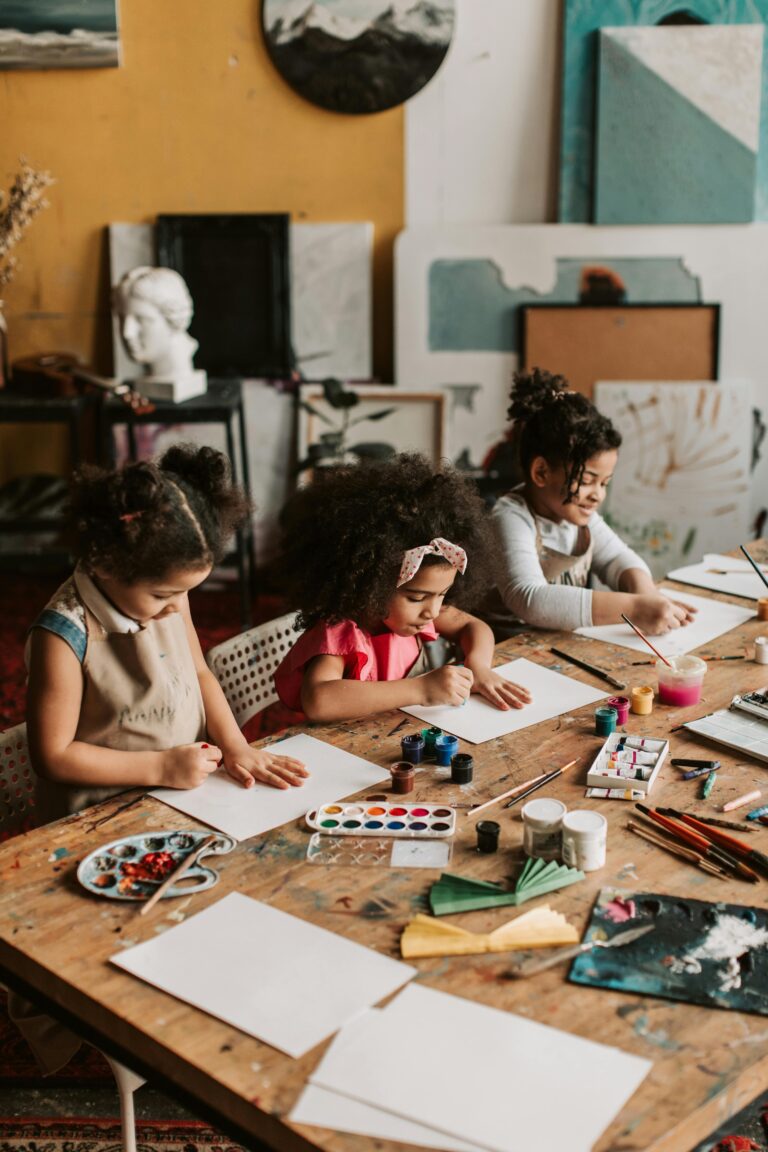
At Accademia dei Piccoli documentation is part of our teachers’ everyday work. When a group of children gets involved in a project — for example (this is an illustrative scenario) building a “house for birds” — the teacher observes and records. They photograph each stage of the work and note down the children’s conversations: “we need to make a roof, because when it rains the birds will get wet,” says one child. “And I want a window so the birds can look at the sky,” adds another.
These notes are then put together into the project documentation, which tells a story: how the idea came about, what questions the children asked, what solutions they came up with, what surprised them and what was difficult. Documentation can take the form of panels on the preschool walls, albums or presentations for parents. Any form is good, as long as it conveys the depth and authenticity of the process.
Documentation for teachers
For teachers, documentation is an invaluable tool for reflection. Looking through photos and notes, a teacher can see patterns they missed in the bustle of the day — notice that one child consistently takes the role of leader while another prefers to work alone, or discover that a topic that seemed exhausted is raising new questions. Based on these observations, the teacher plans the next steps — not from a handbook, but from life. This is the essence of progettazione: flexible planning that grows out of careful observation rather than top-down guidelines.
Documentation for children
Perhaps the most beautiful aspect of documentation is its value for the children themselves. When a child from the youngest group looks at photos from a project they took part in a month ago, they see themselves in action — building, painting, experimenting. This builds memory and identity: “I am someone who creates, discovers and can do things.” Older children love returning to the documentation, commenting on their work and comparing it with newer pieces — and seeing for themselves how much they have learned. It is a far more powerful way of building self-confidence than any “well done” stamp or top grade.
Documentation for parents
For parents, documentation is a window onto a world they do not see every day. They know their child spends several hours a day at preschool, but what exactly do they do during that time? Documentation answers this question far more richly than a brief “it was fun” or “someone had an argument with someone today”.
Sources and further reading
- Project Zero, Reggio Children, Making Learning Visible: Children as Individual and Group Learners, Reggio Children, 2001.
- Rinaldi C., In Dialogue with Reggio Emilia: Listening, Researching and Learning, Routledge, 2006.
- Edwards C., Gandini L., Forman G. (eds.), The Hundred Languages of Children: The Reggio Emilia Experience in Transformation, 3rd ed., Praeger, 2012.

About the author
Katarzyna Jaszczuk
Methodological Director of Accademia dei Piccoli preschool in Kabaty. She is responsible for the Reggio Emilia-based curriculum, pedagogical documentation and supporting teachers in their daily work with children. Meet our team
Read also: The parent’s role in the Reggio Emilia approach — partnership instead of delegation · What is the Reggio Emilia approach and why does it change the way we think about education?
Would you like to see what this looks like at Accademia dei Piccoli?
You are welcome to visit our preschool in Kabaty (ul. Ekologiczna 4). Book by phone: +48 606 125 126 or by email: kontakt@piccoli.pl. You will find answers to the most common questions in our FAQ.